
philosophy
Zen &
The Way of Tea
Finding calm within movement.
The tea ceremony is not simply about drinking tea.
It is an invitation to become fully present.
the way of tea
Tea as meditation in action.
The tea ceremony is not simply about drinking tea.
It is an invitation to become fully present.
Sit quietly in a tea room and you may notice something unusual: you are alert and calm, focused and relaxed.
Your mind softens without effort. You are aware of every movement — the hands of the host, the sound of water the warmth of the bowl — but you are not analysing or judging.
You are simply here.

This is the essence of the Way of Tea:
meditation in action.

Cantempory
Practice
Sen no Rikyù
Murata Jukó
(Wabi-sha)
Zen
monasteries
China
(9th century)
Japan
(12th - 16th century)
THE HISTORICAL CONNECTION
Zen • Tea • Japan
The link between Zen Buddhism and the tea ceremony is deeply rooted in jananese history. Tea arrived from China in the 9th century, brought by Buddhist monks who used it to stay awake during long meditation sessions.
Between the 12th and 16th centuries, tea and Zen became truly intertwined, shaped by influential figures such as Eisai, Murata Jukó and Sen no Rikyù.
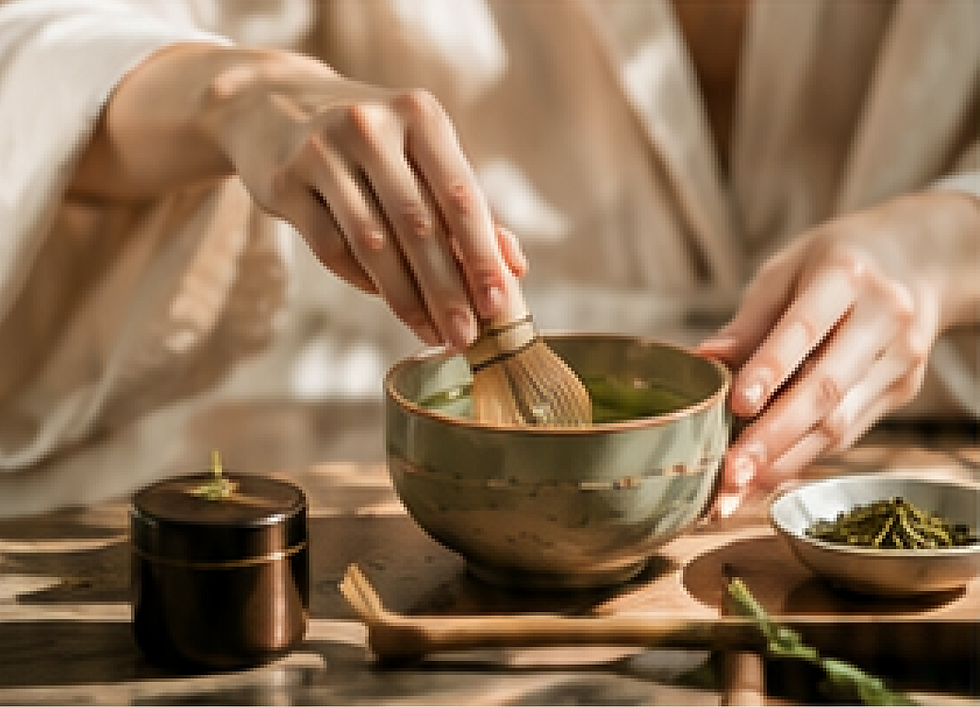
TEA AS MEDITATION
A practice of presence.
The Way of Tea transforms an ordinary activity into an opportunity for complete attention. It is not about doing more, but about being fully present in what you are doing.
ATTENTION
Each movement has meaning.
repetition
Ritual creates rhythm
the senses
Sound, texture, aroma, taste
body & mind
One action, whole presence


Not a place to escape.
But a way to return to what is already here.
melody healing space
THE zen principles
Timeless wisdom for everyday life.
The Way of Tea reflects many of the principles of zen. These teachings invite us to slow down, to appreciate the present moment and to find beauty in simplicity, imperfection and nature.
MUSHIN
無心
MA
間
ICHIGO ICHIE
一期一会
WABI-SABI
侘寂
KANSO
簡素
FUKINSEI
不均斉
SHIZEN
自然
The mind without unnecessary interference.
The space between things.
One time. One meeting.
Beauty in imperfection.
Simplicity
The beauty of asymmetry.
Naturalness

the silence of tea
Silence is not empty.
Silence in the tea ceremony is a postive presence.
It allows us to hear, to feel and to truly receive.
FOUR TYPES OF SILENCE
Contemplative - Space to observe
Working - The sounds become a form of music
Shared - A silent connection
Receptive - Space to let the experience settle
静版の中に真の愛かさがある
Within the stillness lies the essence of true love.
finding calm within movement
Stillness can be found in movement.
Walking, cleaning, cooking or preparing tea -
each action can become a meditation.
The movement becomes slower because attention becomes deeper. And somewhere within gthe movement, the mind becomes quite.


RETURN TO THE PRESENT MOMENT
Letting go of everything that arises.
Zazen is the central practice of Zen Buddhism. The word translates simply to “seated meditation.”
Unlike some meditation traditions that focus on visualization or mantra, zazen is remarkably bare. You sit. You breathe. You observe. Thoughts come and go like clouds. The practice is not to stop thinking, but to stop chasing thoughts — to return, again and again, to the present moment.


The melody way
A simple ritual.
At MELODY HEALING SPACE, the Way of Tea is an invitation to explore the values behind the practice: presence, simplicity, attention, silence, nature, impermanence and space.
A tea ritual
-
Prepare your tea
-
Feel the warmth of the bowl
-
Notice the aroma
-
Take a conscious breath
-
Come back to yourself.
